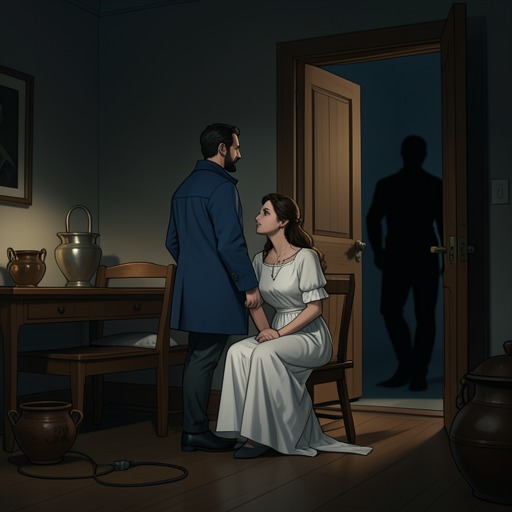
Pinocchio Runs Away to Toyland with Lucignolo
Pinocchio (Tania Zamorsky Edition)Pinocchio Runs Away to Toyland with Lucignolo is the turning point in which Pinocchio gives up the future he has been promised as a real boy and chooses, instead, an escape from study and restraint. His departure follows a day of apparent resolve: he has promised the Blue-Haired Fairy that he will become a good boy, and he is helping prepare for a celebration of that anticipated change. But his closest school friend offers a rival future, one organized around uninterrupted play. Pinocchio’s journey makes that temptation concrete, and its eventual bodily consequence exposes the cost of choosing it.
The Promise and the Invitation
The escape is set against the prospect of a joyful celebration. The Blue-Haired Fairy has arranged a breakfast for the following day, inviting Pinocchio’s school friends to mark the great occasion. She has prepared two hundred cups of coffee and milk and four hundred buttered rolls. Pinocchio is delighted by the news, and the contrast between this welcome future and his later departure gives the episode its central irony: just as the promised transformation seems close, he leaves it behind.
The Blue-Haired Fairy allows him to go into town to invite the other children, but tells him to be home before nightfall. Pinocchio promises to return within an hour. When she cautions that children are quick to make promises and often slow to keep them, he insists he has learned from experience and will not fall into trouble again. He leaves singing and dancing, outwardly buoyant and apparently confident in his own reform.
Lucignolo’s Alternative
Pinocchio’s search for Lucignolo takes repeated attempts. He goes to his friend’s home three times without finding him, then finally discovers him hiding beneath the portico of a farmhouse. Lucignolo says he is waiting for midnight so he can leave for a distant destination. He describes it as the finest country in the world, a place of abundance and delight called Toyland, and invites Pinocchio to come with him.
The appeal is not simply that Toyland offers more games. Lucignolo presents it as a country without schools, teachers, or books, where children never study. Its calendar is a burlesque of ordinary discipline: each week has six Thursdays and one Sunday, while the autumn holidays begin on January 1 and end on December 31. Days there are spent playing and having fun from morning until night, then sleeping before beginning again. The exaggerated calendar turns school avoidance into the organizing principle of an entire society.
At first Pinocchio refuses. He says that he has promised the Blue-Haired Fairy to become a well-behaved boy and intends to keep his word. Because the sun is setting, he says he must hurry home before night. His refusal shows that he understands both the obligation and the immediate choice before him; it is not ignorance of the promise that leads to his eventual departure. Lucignolo counters that the Fairy may scold him and then calm down. As darkness falls, Pinocchio’s resolve gives way to the company and invitation he has been resisting.
The Night Departure
The two wait until night has fallen. In the distance, a small light appears, accompanied by the sound of bells and a faint trumpet. The approaching vehicle is a Toyland Carriage, its wheels wrapped in tow and rags so that it makes almost no noise. Twelve pairs of donkeys pull it. The carriage is already crowded with boys between eight and twelve, packed together so tightly that they can scarcely breathe. Yet none complains: anticipation of a country without books, schools, or teachers seems to outweigh their hunger, thirst, fatigue, and discomfort.
When the carriage stops, its driver invites Lucignolo aboard, and Lucignolo accepts. Pinocchio initially remains outside. The driver says there are no seats left, but offers him the place beside the driver as a mark of welcome. Pinocchio’s hesitation lasts only long enough for Lucignolo to tell him not to dwell on gloomy thoughts and to imagine the noise and play ahead. Pinocchio sighs repeatedly, then asks to come too. In asking for a place, he reverses the refusal he made only hours earlier and chooses the journey over returning to the Fairy.
As the carriage moves along the road, Pinocchio hears a low, indistinct voice warning that he has insisted on having his own way and will regret it. He looks around but sees no one who could have spoken: the donkeys are galloping, the boys are asleep, Lucignolo is snoring, and the driver is singing to himself. The warning accompanies the departure without stopping it. By dawn the carriage reaches Toyland, and Pinocchio obeys the driver without protest as the journey resumes and ends there.
Toyland and the Cost of Escape
Toyland’s promised freedom is embodied in the scene of arrival. Its population consists entirely of boys, from eight years old to fourteen. The streets are filled with games, shouting, racing, performances, and noisy amusements; makeshift theaters are crowded from morning to night. The place appears to have abolished the institutions Pinocchio had just promised to accept. Its energy fulfills Lucignolo’s description, but the crowded carriage and the boys’ disregard of basic discomfort already complicate the idea that this freedom is uncomplicated happiness.
The escape also begins a delayed transformation. After five months of revelry, Pinocchio is astonished to feel a pair of donkey ears growing and becomes a donkey, tail and all. The bodily change supplies the consequence that the earlier warning could only foreshadow. His chosen passage away from study and the Fairy’s care does not lead to the human identity he had been offered; it makes his abandonment of that future visible on his own body.
Narrative Significance
The episode is shaped by a repeated gap between intention and action. Pinocchio promises to return within an hour, declares that he will keep his promise to the Fairy, and even starts to hurry home as night approaches. Each declaration is overtaken by the next attraction: first Lucignolo’s account of Toyland, then the waiting carriage and its invitation. The journey therefore turns a familiar moral choice into a sequence of small reversals, culminating not in a sudden abduction but in Pinocchio’s own request to board.
Lucignolo’s role sharpens the conflict. He is Pinocchio’s dearest school companion, but also the laziest and most mischievous boy in the school. His nickname is linked to his thin, lanky build, likened to the wick of a small lamp. Pinocchio’s affection for him helps make the invitation persuasive: the flight is both an escape from school and a choice to follow a beloved friend. The five-month delay before the donkey transformation stretches the distance between decision and consequence, allowing Toyland’s apparent freedom to precede and then give way to the cost of the choice.